
MASST
Imagine you’re a fun, single MS2 spectrum. You’ve scrolled the spectral libraries, perused those mass queries, and even tried your hand at networking, but the fit is just never right. You know that somewhere out there, in those billions of unannotated spectra, is your perfect match. But how to find them? You’re just a small spectrum in a very big database.
Enter MASST. I like to think of MASST (or the Mass Spectrometry Search Tool) as speed dating for MS2 spectra. Basically, MASST is an incredibly fast search tool for matching MS/MS data. How fast? I’ll let this figure do the talking.
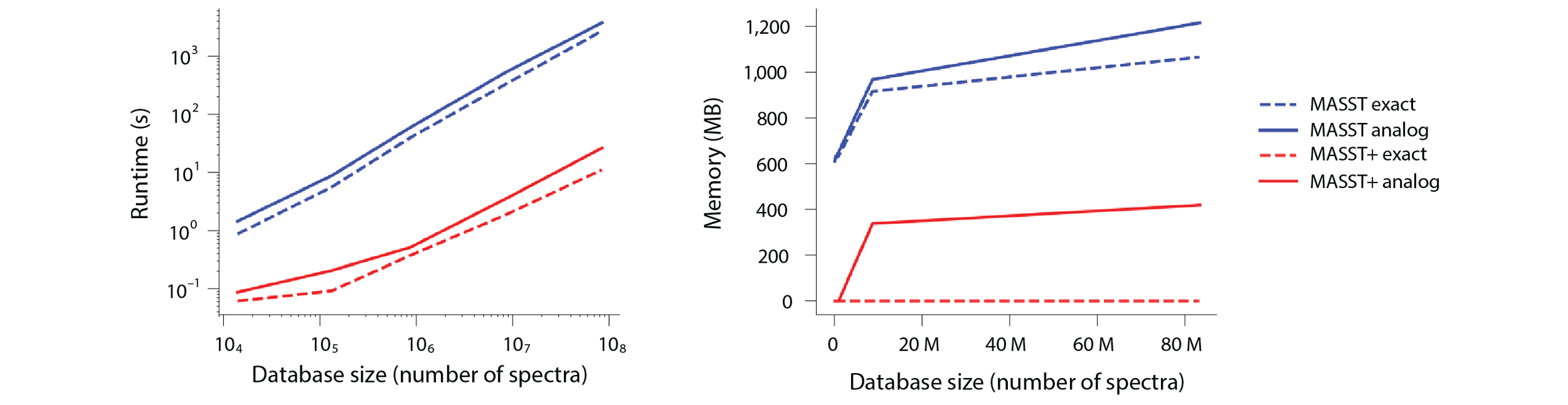
MASST+ algorithm search speed and memory requirements. Figure adapted from Mongia et. al.
Yes, that’s about 15 seconds to search 1 billion spectra. Welcome to the new world of spectral speed dating.
How is MASST different from library matching?
MASST and library annotation both match similar MS2 spectra, so what’s the difference?
To get a library match, your compound of interest must first be in your spectral libraries. If you’re studying novel compounds, that library spectra isn’t going to exist. You can collect a library spectra for your new compound and use it to search other data.* However, this requires several extra steps and takes some time. Library matching to one billion spectra runs in the range of hours instead of seconds.
MASST is essentially a library search on steroids. Instead of searching your experimental spectra of interest against a set of library spectra, you search your spectra of interest against all MS2 spectra you’ve ever collected. This means you’ll detect matches whether or not they’ve ever been annotated with your spectral libraries. Plus, you can run this analysis in seconds and perform analog searching.
Analog searching looks for common mass differences of your spectra of interest. Maybe your compound wasn’t detected in a sample, but the methylated form of it was. Analog searching can rapidly identify potential metabolites of your target compound and can even identify closely-related compounds that do have library matches.
At its best, MASST can map an unknown compound across the tree of life and provide you with specific bacterial strains and culture conditions that produce it. At its most basic, MASST will return a list of file names that contains matches for your spectra of interest. Both are incredibly powerful.
What MASST can do:
List every time a spectra has ever been detected in all your historical data in seconds. Answer the question “Have we ever seen this before?” in about as much time as it takes to ask it.
Enrich results to provide detection rates across database metadata. Is this compound found in 50% of brain samples but 1% of kidney samples? Is it only produced by a specific strain of E. Coli? Or is it widely detected across an entire class of plants?
What MASST can’t do:
Annotate your compound. MASST will provide you with every match to your MS2 spectra, but it can’t tell you the structure or chemical identity of the compound. However, used in conjunction with library matching and molecular networking, MASST can get you pretty close.
MASST is only as useful as your metadata. Nothing is worse than getting 10 matches to “this_sample_name_made_sense_to_Mark_in_2011.mzML”. In order to use MASST to its fullest potential, you have to populate your MASST database with metadata that helps you understand what a match actually means. One cool application of this concept in the academic space are the domain-specific MASST tools. These tools map MASST matches through taxonomic trees, allowing you to visualize which families, species, and strains produce your compound of interest.
What we’re building:
MASST is already available in Ometa Flow. We allow clients to both create their own MASST databases or use publicly-available databases that house billions of spectra. However, we think we can do better. We have plans to improve MASST databasing to make it easier to add important metadata and make your MASST searches more informative. For that, we need your input on what types of metadata you’d like to search and how it should be displayed. Our hope is to make MASST a flexible tool that allows you to rapidly map compounds across whatever groups, systems, manufacturing lines, taxonomic trees, lakes, rivers, and mountains your heart desires. Here’s a taste:

If you’d like to learn more about these changes or have great ideas on how to make MASST even better, please let us know.
*The classic “Putative match to X please contact Y if you have more information” library entry that we all know and love.
Want to learn more?
Read all about domain-specific MASSTs:
Also don’t miss these papers on the algorithms behind the magic:
Have more questions? Contact us.