
Domain-Specific MASST
MASST is a revolutionary new search tool that transforms how scientists interact with mass spectrometry data. Traditionally, identifying a compound in MS/MS data required library matching - a relatively slow process that typically identified less than 20% of the compounds in a sample. In contrast, MASST can search billions of mass spectra in seconds, allowing for rapid searches of both known and unknown compounds across entire databases. These databases include terabytes of publicly-available data representing mammalian tissues, microbial cultures, plant extracts, environmental samples, consumer products, and more. Thus, MASST can reveal a compound’s biological, ecological, and industrial distribution in seconds.
MASST searches can uncover shared metabolic pathways, optimize production, and even help identify both known and novel compounds. However, sifting through tens of thousands of MASST matches can be daunting. This is where domain-specific MASST comes in.
What is domain-specific MASST?
At its core, MASST searches your compound of interest against a database and returns every file where it appears. But filenames aren’t always useful, and scrolling through thousands of them is time consuming. However, pairing MASST results with rich metadata can rapidly highlight important trends. With metadata, you can immediately see that your compound was found in 100% of E. Coli samples but only 5% of Bifidobacterium, or that it was detected in 80% of patients with lung disease but not in healthy volunteers.
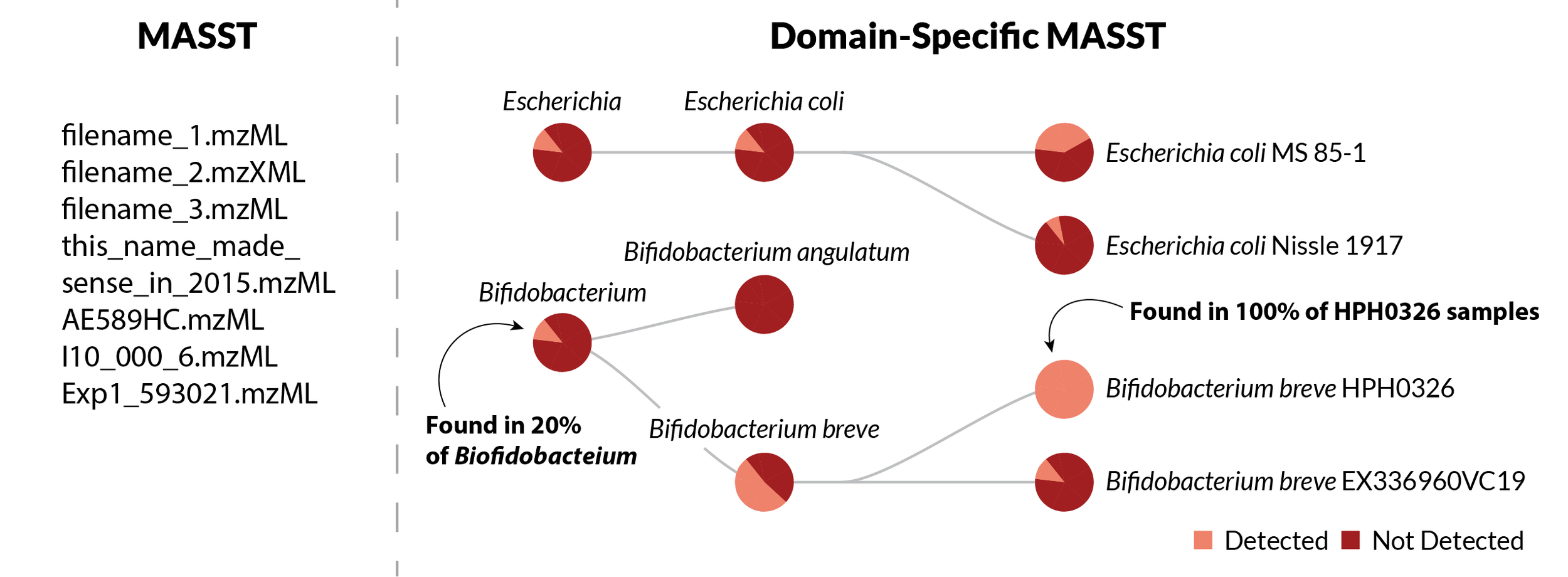
Domain-specific MASST narrows your search to highly curated databases focused on specific sample types. Ometa Flow currently includes the following domain-specific MASSTs:
microbeMASST: ~60K microbial monocultures
microbiomeMASST: ~180K microbial monocultures, synthetic bacterial communities, and host-associated microbiome samples
tissueMASST: ~45K tissue samples from human, mouse, and rat
plantMASST: ~45K plant extracts
foodMASST: ~3.5K food and beverages
personalcareMASST: ~1K personal care products
Note: these numbers are up-to-date as of May 2026, but sample numbers are constantly growing
Searches within these domains return results organized into taxonomic or categorical trees. For instance, a plantMASST search may reveal which genera or species produce your compound. A foodMASST query might show if it’s found in many hot beverages or just black tea. Here’s a few examples of what you can do with domain-specific MASSTs.
microbeMASST
With over 60,000 microbial monocultures - including bacteria, fungi, and archaea - microbeMASST enables fine-grained exploration down to the strain level. This sort of resolution allows you to trace a compound to an individual strain of Burkholderia thailandensis or rapidly screen novel molecules that are distributed across taxonomically diverse microbes.
Use Case 1:You detect a novel drug candidate in an extremophile that is very difficult to culture. A microbeMASST search reveals the same MS/MS signature in Bacillus subtilis, a well-characterized soil bacterium routinely used in industrial fermentation. With that match, you bypass the cultivation barrier and shift production to a strain already suited for scale-up, pathway analysis, and genetic engineering.
Use Case 2: You’ve isolated a cyclic peptide from a soil Streptomyces strain. microbeMASST detects the same compound in marine actinomycetes, hinting at a broader ecological role.
plantMASST
plantMASST contains over 45,000 plant extracts covering hundreds of species. This can reveal phylogenetic patterns and help explore how compound distributions correlate with evolutionary relationships.
Use Case 1: You detect a promising diterpenoid in Taxus brevifolia, known for producing the anticancer drug Taxol. However, the tree grows slowly, is native to old-growth forests, and faces sustainability concerns due to historic overharvesting. A plantMASST search detects the compound in cultivated hazelnut (Corylus avellana), offering a scalable alternative for compound isolation.
Use Case 2:A flavonoid you’re studying appears in lavender flower extracts. plantMASST reveals similar spectra in mint and oregano leaves, suggesting a conserved biosynthetic pathway among Lamiaceae.
tissueMASST
tissueMASST includes over 45,000 tissue samples from humans and other mammals collected under both healthy and disease conditions. This rich dataset allows you to trace compounds across physiology and pathology and even discover new biomarkers of disease.
Use Case: You discover a novel drug metabolite in plasma. A tissueMASST search finds the compound in liver and kidney samples but not in cardiac or neural tissues, guiding your safety and dosing strategy toward the organs most likely to accumulate the compound.
foodMASST
foodMASST encompasses 3,580 food and beverage samples, covering coffees, teas, cheeses, fermented drinks, fruits, spices, and more. Using this catalog, you can ask whether a flavor marker or contaminant is common across an entire food category or confined to a single source.
Use Case: You’ve identified a fruity ester that boosts perceived juiciness in apple juice. A foodMASST search finds the same compound in red guava. Armed with that knowledge, you can explore guava peel infusions to heighten “fresh-picked” notes without additional sweeteners.
personalcareMASST
With almost 1000 cleansers, lotions, shampoos, and serums, personalcareMASST lets you track the distribution of cosmetic additives, spot unexpected degradation products, or compare formulations at a glance.
Use Case: You’re monitoring a preservative breakdown product. personalCareMASST flags it in specific moisturizers, revealing a formulation-specific reaction that you can now troubleshoot with your R&D team.
Custom MASSTs
The domain-specific MASST databases above are already available within Ometa Flow, but your research questions may require a different type of database. That’s why Ometa Flow supports custom MASST databases - letting you mine your own historical data and focus results on your specific use case. These custom databases can be built with public or private data and are securely housed within your organization.
Whether you're a pharmaceutical company looking at tissue samples, a microbiologist with hundreds of microbial strains, or a food scientist working with a unique fermentation library, custom MASST lets you build searchable datasets aligned with your research questions.*
If you’re interested, contact us to learn more about building your own custom MASST databases.
Want to learn more?
Read all about domain-specific MASSTs:
Also don’t miss these papers on the MASST algorithms:
Have more questions? Contact us.
*If you’re an academic or non-profit researcher, you can use GNPS2 MASST free of charge. While the GNPS2 team is always happy to add your public data in existing domain-specific MASSTs, GNPS2 does not support the building of custom MASST databases.