
What to look for in metabolomics CROs
So you want to do metabolomics, great!
All you need are some samples, extraction solvents, highly skilled research scientists, a grumpy mass spectrometrist, a million dollar instrument…
While we could argue that everyone deserves the life-giving experience that is trying to maintain a QE, we understand that not every company can run their own metabolomics experiments. For many companies, the best option is to hire a contract research organization (CRO) to run their samples. And while we’re not a CRO, we have helped a lot of people analyze data from CROs. We’ve had some great experiences, but we’ve also found that asking the right questions before the data are collected can make a huge difference. So here are the most important things we would ask when considering a metabolomics CRO.
Targeted analysis
Targeted metabolomics focuses on a handful of metabolites and is a great option if you already know what you need to measure. Most studies that assess the stability or metabolism of a lead compound are targeted experiments (although we would argue untargeted metabolomics has a role here as well). Here are the questions we’d ask when running a targeted experiment:
Question 1: Are you running MS or MS/MS?
This question gets at how much information you’ll receive about each metabolite in your sample. MS experiments run one round of mass spectrometry (MS1) to measure the mass and retention time of your target molecules. This provides two data points (mass and retention time) for identifying your metabolites of interest. MS/MS experiments run an additional round of mass spectrometry (MS2) that breaks molecules into fragments and measures the mass of those fragments, providing information on the chemical substructures within a molecule.* Since many molecules produce dozens of MS2 peaks, MS/MS greatly expands the number of data points available to identify metabolites.

Example of MS1 and MS2 spectra from the compound azithromycin.
For most targeted applications, MS experiments are sufficient. MS can provide accurate, absolute quantification of target molecules in relatively simple solutions. However, because MS greatly relies on retention time to identify compounds, it is essential that the CRO runs reference standards of your target compounds alongside your samples. This means either you or they must have these compounds purified and ready to be run with your samples.
Question 2: How are you running standards?
Reference standards may be the single most important factor when running a MS experiment. Because thousands of compounds can share the same chemical formula (and thus the same mass), mass alone is not enough to identify a metabolite in a complex sample. Retention time is thus key to separate your compound of interest from its structural isomers. However, retention time is fickle, and can drift based on experimental conditions, instrumentation, or times of day. Thus, it is essential to run a reference standard alongside your experimental samples to make sure you know your compound’s retention time at that particular moment.
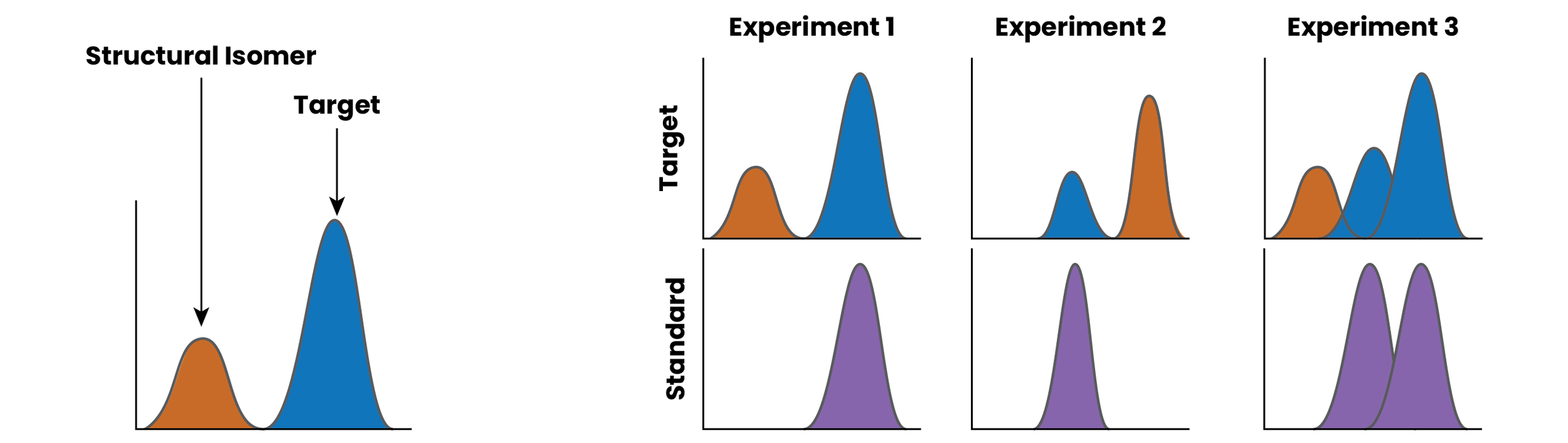
Running reference standards regularly can help identify compounds of interest and correct for retention time drift.
Running standards is also necessary if you need absolute concentrations of your metabolite of interest. Mass spectrometry signals don’t always scale linearly with concentration, so in order to get accurate concentrations, you need to run a standard curve with known concentrations of your purified compound. If this isn’t done, the best you can get are relative concentrations (eg, this compound was two-fold higher in X vs Y).
One last note about MS experiments is that they tend to get less accurate with 1) the more metabolites you’re trying to measure and 2) the more complex your samples. The presence of other metabolites can influence retention time and detection efficiency, which is why a good targeted analysis will run reference standards in a similar matrix as the experimental samples.
If you’re planning a targeted experiment, you have a lot of great options for CROs. Many CROs pride themselves on having an extensive list of target compounds, and can quickly develop new assays for analytes that aren’t already on that list. However, this does mean that you have to know which targets you’re looking for. And while targeted analyses are great for measuring the compounds you already know, they are never going to tell you about the compounds you don’t.
Untargeted analysis
Untargeted metabolomics is all about discovering unknowns. And while targeted analysis is a robust and relatively standard technique, untargeted analysis is the wild west. There isn’t even consensus on what untargeted really is. While we would argue that untargeted metabolomics is a technique where everything that is detected is reported, some CROs define untargeted analysis as targeted analysis, but with more targets. Thus, you’ll often see panels of hundreds to thousands of analytes labeled as “untargeted”.
While there is nothing wrong with these panels (in fact, there are a lot of great ones out there), they are simply an extension of your typical targeted experiment: they measure what we know. The problem is that most of the metabolites detected in a truly untargeted experiment are unknown. A panel of known metabolites, no matter how many compounds it contains, is never going to provide actionable information on those unknowns. So while these large panels are a great option if you’re trying to see how a compound affects known metabolic pathways, they aren’t a great option if you’re looking for something new.
Ask yourself: if you’re looking for the next breakthrough biomarker, is it more likely to be one of the thousands of known metabolites that have been studied for years, or one of the millions of unknown metabolites that are yet to be identified?

So how do you go about discovering these unknowns?
Question 1: Are you running MS or MS/MS?
While MS experiments work well for targeted analyses, they are not sufficient for untargeted analyses. The most an MS experiment can give you is the chemical formula of a novel compound.** That means it can narrow your lead compound down to one of - hundreds? thousands? - of possibilities.
What you need for untargeted metabolomics is MS/MS. Those MS2 peaks provide crucial information on which chemical substructures exist within a molecule, and can be used to identify compounds or extend annotations with molecular networking. Thus, when performing untargeted metabolomics, we highly recommend running MS/MS on all your samples.
You may encounter CROs who run MS/MS on a reference sample and then MS on the rest. This is a similar concept to MS experiments, except that MS2 information is used to identify compounds instead of a reference standard. This means this technique is subject to all the caveats of a targeted MS experiment - you have to hope that your reference sample is representative of all your experimental samples and that retention time doesn’t drift over the course of your experiment - plus you don’t have reference standards to compare to in a pinch. While the proponents of this method claim that MS results in more accurate quantification of metabolites, those effects are minimal on a well-optimized modern instrument. In our opinion, it’s not worth losing valuable information on your biomarker for marginally cleaner peaks.
Question 2: How are you identifying metabolites?
While there’s no reason not to use reference standards to identify metabolites in an untargeted experiment (in fact, it’s a great idea if done correctly), most untargeted experiments will use library matching to identify metabolites. This method compares the MS2 spectra in your samples to libraries of MS2 spectra from known compounds. While this can be a rapid and accurate way to identify thousands of metabolites, it is only as good as the MS2 libraries that are used. In addition, library matching generally won’t distinguish between stereoisomers or other very structurally-similar compounds because they often do not factor in retention time or chromatography conditions. Thus, it’s important to ask how library matching will be done and how accurate metabolite identifications are expected to be.

Example of MS2 library matching. The experimental spectrum for sucrose matches to the library spectrum of sucrose (top), but not to the library spectrum of azithromyin (bottom).
Of course, library matching is still not going to provide information on unknown metabolites. There are several methods for investigating unknowns (including our favorite: molecular networking), but the common thread among them is that they are all going to be predictions. It’s important to know how predictions are made and if there are any good alternate identifications.
In the end, no method for identifying metabolites is going to be completely accurate. This brings us to our final and most important question:
The most important question of all:
Can we get the raw data?
The raw data is the single most important thing you can get out of an untargeted metabolomics experiment. While a spreadsheet with a list of metabolites and their concentrations is helpful (especially if you’re new to the field), it doesn’t provide the same level of information that the raw data does. That’s because no matter how compound identification is performed, a spreadsheet will always be a snapshot of which metabolites were known and what analytical methods were available at that moment in time. The raw data is a treasure trove that you can continue to mine for years after collection.
Untargeted experiments are so complex that no one analytical method (or even suite of analytical methods) will reveal everything in a sample. But, as our ability to predict and identify metabolites gets better, raw data can always be reanalyzed to discover new insights. Innovative analytical strategies, such as MassQL or MASST, continue to push the boundaries of what information we can extract from raw data. This means that data collected today could have immense value in the future, especially with the advancement of machine learning and AI tools. I’ve lost count of how many times I’ve gone back to a tried and true dataset only to discover something new. You should be able to do the same.
Raw data also allows you to verify the accuracy of your metabolite identifications. Even if you don’t have the time or expertise to sift through a bunch of .raw or .cdf files now,*** they may prove invaluable later. For instance, imagine running an experiment with reference standards, only to discover that one of those standards was incorrectly purified. With the raw data, you have the opportunity to reanalyze and identify the correct compound without having to rerun the entire experiment.
Finally, if this seems like a lot, never fear. There are a lot of excellent metabolomics CROs out there. But if you do encounter a CRO that doesn’t have a great answer to these questions, we’d suggest looking somewhere else.
*There is also MSn which is super cool but still cutting edge.
**Plus maybe some information on its polarity, size, or hydrophobicity depending on what type of column was used.
***Why not .mzML? If you read our blogs, you’ll know that mass spectrometry data comes in a wide variety of file formats, most of which are proprietary and only usable within a very narrow range of analysis tools. However, there is a standard open-source format (.mzML) that can be used across different instruments and analysis softwares (including Ometa). While converting data to .mzML isn’t difficult, it’s not foolproof, and we have encountered instances where a CRO did it wrong. Thus, it’s always a good idea to get the raw files (and the converted .mzMLs if they offer) just in case you need to re-do the conversion in the future.
Also, if you don’t have the resources to analyze your data now, we do offer analysis contracts…