Everything Bagel
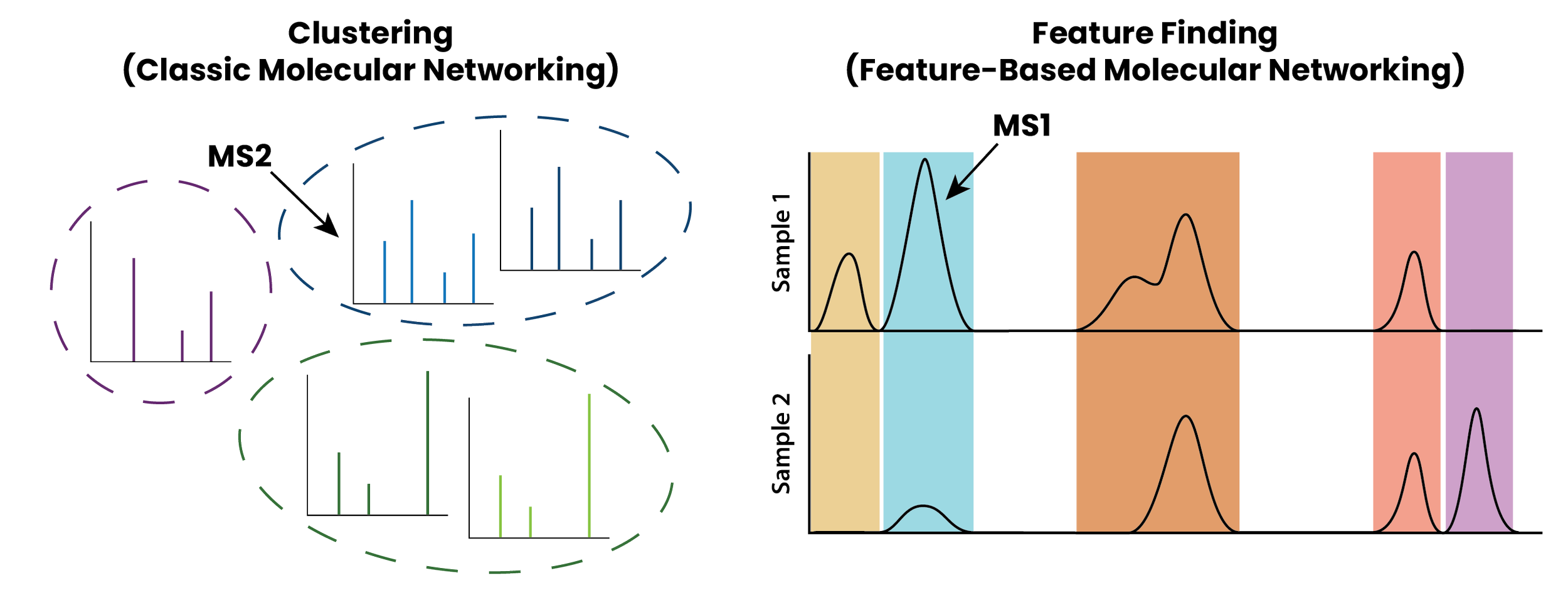
If you’ve read our explanation of classical vs. feature-based molecular networking, you’ll know that there are two main ways to detect the same compound across multiple samples. The first, which forms the basis for classical molecular networking, uses MS2 information to cluster similar MS2 spectra together, ignoring retention time and MS1 information entirely. The second, which forms the basis for feature-based molecular networking, uses MS1 peaks to perform feature finding, detecting similar molecules based on retention time, peak shape, and precursor mass instead of MS2 spectra.
Each of these methods has its strengths and weaknesses, which you can read more about here. However, feature-based networking’s most annoying disadvantages has always been manual parameter tuning. Most feature finding tools require users to set dozens of parameters, which often have to be optimized for each new dataset. Setting these parameters incorrectly can lead to poor quality or even misleading results. Thus, running feature finding often becomes an interactive process of running samples, then manually checking results, then tweaking parameters and running again. While this isn’t necessarily a problem for small datasets, it can become a long and tiresome process for larger datasets.*
Enter everything bagel.** Everything bagel is a new feature finding tool designed to overcome the issues with manual parameter tuning by having the workflow itself tune parameters based on the input data. It uses a combination of detecting instrument types, assessing noise levels, and iteratively performing RT shift analysis to find the best parameters for your data while you get your coffee. Although that coffee had better be instant because have we told you it’s fast? It is SO FAST. Here’s a comparison to our Molecular Networking workflow, which we’ve spent the last two years optimizing for speed and computational efficiency (see Notes below).
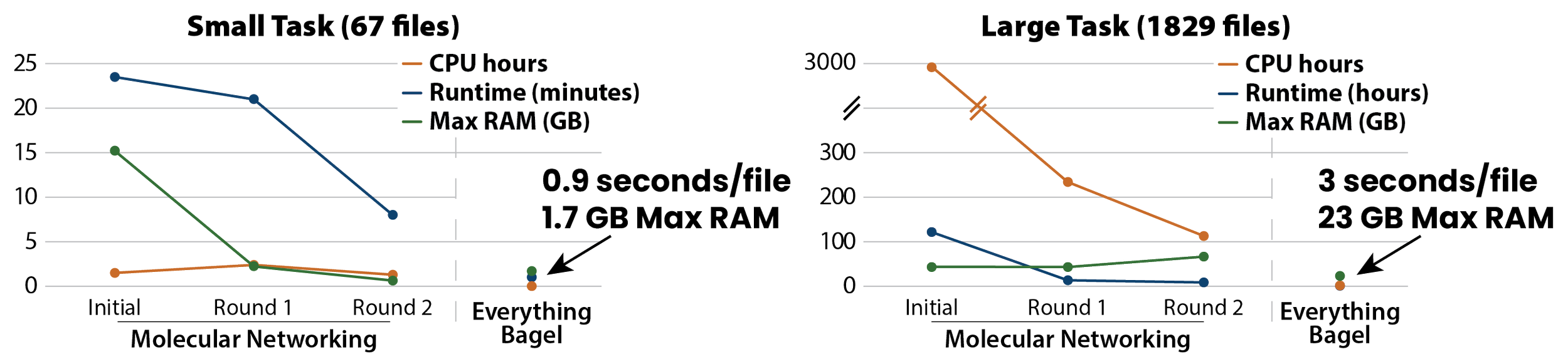
Runtime, CPU hours, and Max RAM for a small (67 MS/MS files) and large (1,829 MS/MS files) task using Ometa’s Molecular Networking and Everything Bagel workflows. Round 1 and 2 refer to rounds of optimization performed by the Ometa team to improve the computational performance of the Molecular Networking workflow.
You read that right. This workflow can perform feature finding, library searching, and molecular networking in less than 5 seconds per file on a laptop’s worth of computational power.
But of course, none of this would be worth it if the results aren’t any good. But just take a look at these results:
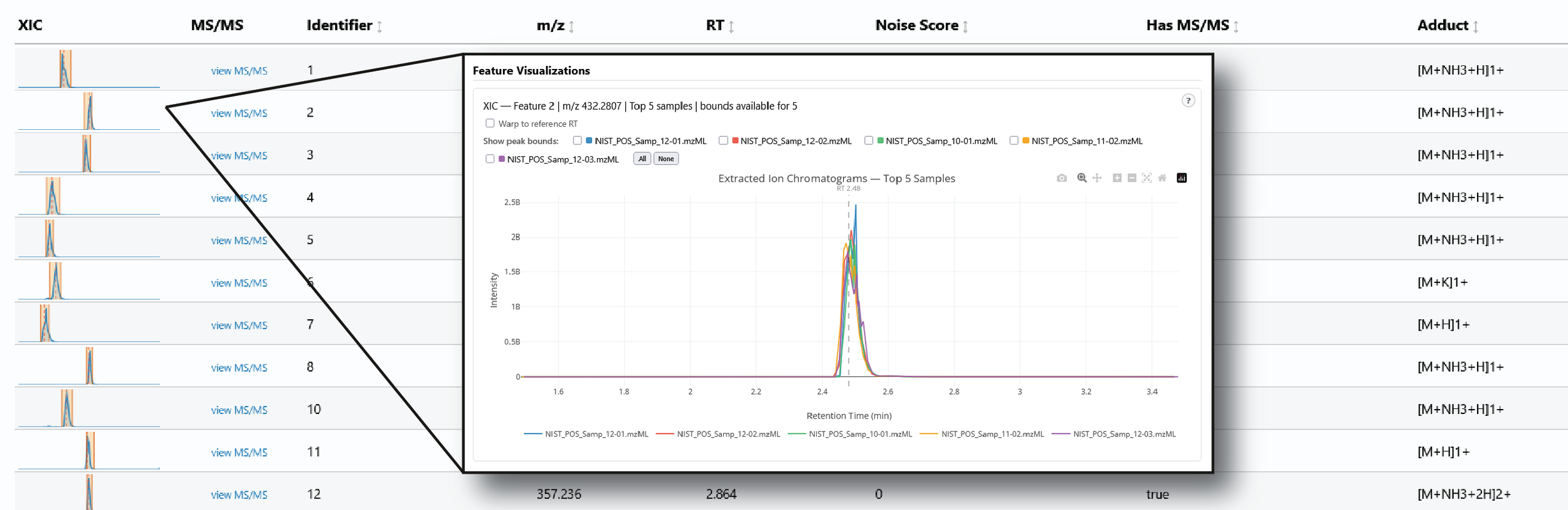
Example feature finding results from everything bagel. The full task with all results can be accessed here, you can check out the feature inspection dashboard to view all features.
This is all in a single pass without having to manually set feature finding parameters. If you’re interested in diving in deeper, you can check out all the results for this example task here.
I know this may feel a little too good to be true. I definitely felt this way when I started using it. Also, if you’ve been around the small molecule block long enough, you likely have a favorite feature finding tool that you’ve mastered in the painful crucible of iterative optimization. So, we’ve created a tool comparison dashboard that allows you to upload features from other tools and compare them to the features found by everything bagel. Here’s an example where we’re comparing features found by everything bagel above to features found in the same files by MZmine.***
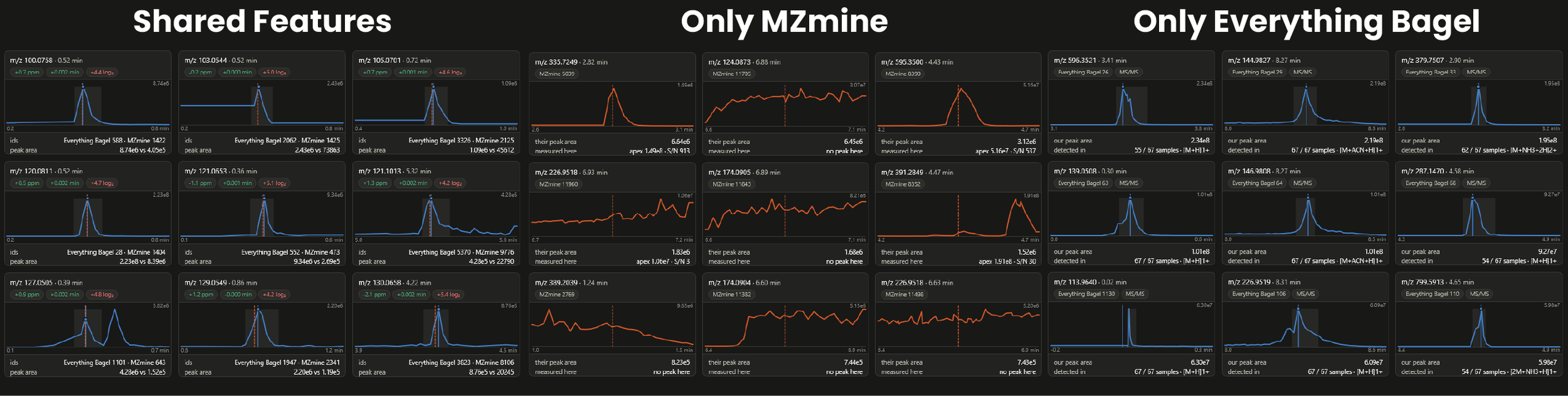
Shared and exclusive features for the same dataset in Everything Bagel and MZmine. The full comparison can be accessed here.
Everything bagel is available now on our platform (for industry) and GNPS2 (for academics). Get in touch if you’d like to check it out!
Notes:
While it is faster, everything bagel doesn’t replace classical molecular networking. For instance, classical molecular networking may still be the best choice for repository-scale analyses where the input data comes from different instruments or chromatography methods.****
While everything bagel was trained on thousands of mass spectrometry files from the public MassIVE database, it wasn’t trained on your data. We are still actively improving the algorithm, so if everything bagel doesn’t work well on your data, please let us know.
Because it is so fast and efficient, you can run everything bagel on a local computer rather than on a server-based system. For instance, you can use the local version on an instrument computer to analyze data coming off your mass spectrometer in real time. Ometa offers a workflow to import local everything bagel results onto our server-based software, allowing you to more easily track and share results with your colleagues.
*Definitely not spoken from personal experience
**Why everything bagel? Because it packs an entire universe of tasty mass spectrometry tools into one delicious, easy-to-eat snack of a workflow. Obviously.
***This uses MZmine 3.9.0, which is an older version but is open source. If you want to do this comparison yourself, let us know [insert link].
****We do have a repository-scale analysis option in Everything Bagel that analyzes each dataset individually and then combines the results, but that’s a little out of scope for a blog post.
Want to learn more?
Read the everything bagel preprint here
Have more questions? Contact us.