
ModiFinder
Have you ever met one of those wizards who can look at an MS2 spectrum and tell you how and where a molecule’s been modified? Each MS2 peak provides information about what substructures inside a molecule. So, if you compare two MS2 spectra, you can tell which substructures are shared and which are not, which allows you to pinpoint where a modification might have occurred.
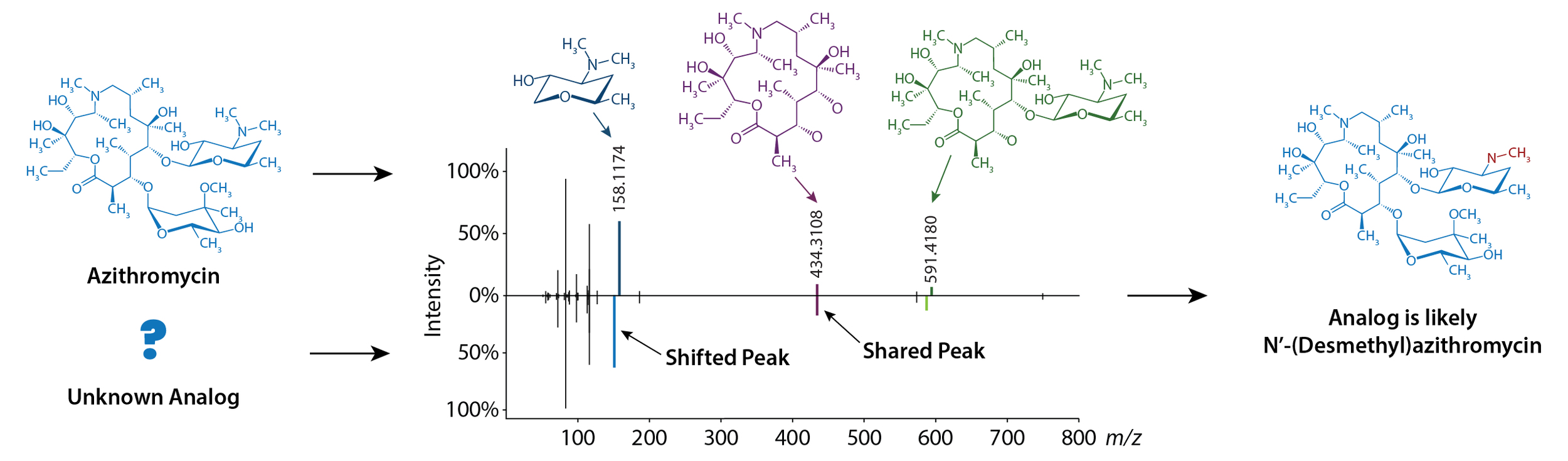
While this is theoretically possible, most of us are mere mortals who don’t automatically draw SMILES structures in their heads whenever they see a mirror plot. And while you can get better at recognizing certain patterns, especially within a molecular family (aka, wizard school), it can be a very slow and tiresome process. But, it is exactly the type of process that computers excel at.
ModiFinder uses the same process that a human would use to manually interpret differences in MS2 spectra: it assigns putative substructures to each MS2 peak, and then uses the shared and shifted peaks in the unknown spectrum to determine which part of the structure is most likely to be modified. This information is then visualized as the parent structure with the most likely modification site highlighted.
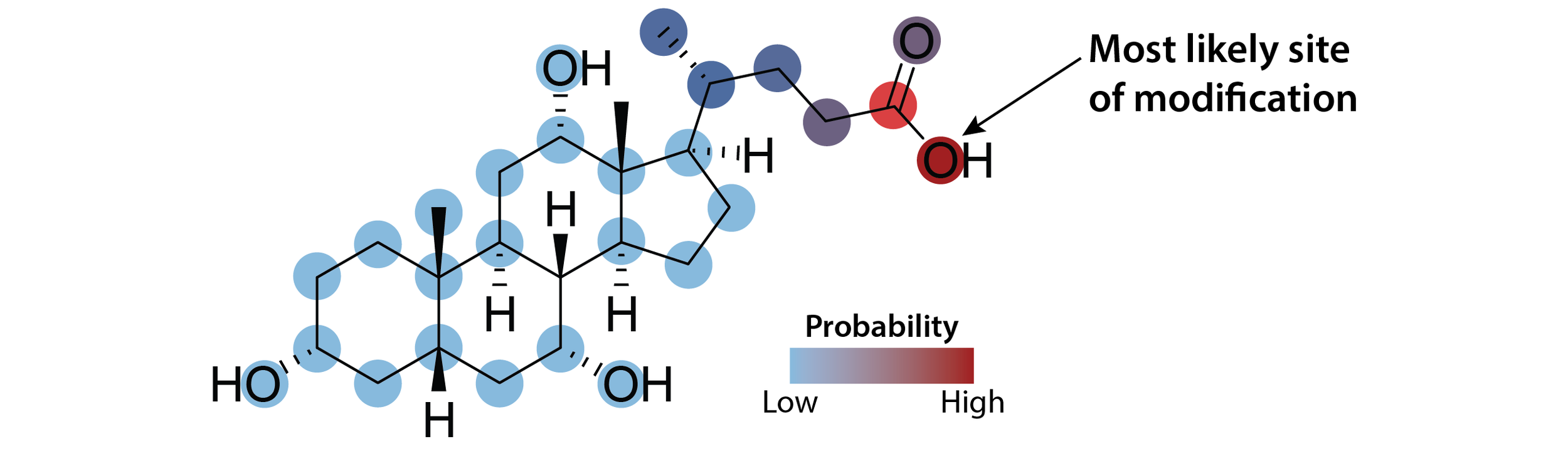
Unlike manual spectra review, which can take hours (or days), ModiFinder can do all this in seconds. That is why, while ModiFinder is available in Ometa Flow as a high throughput workflow and an interactive dashboard, our favorite way to use ModiFinder is within a molecular network itself. All you have to do is click on the edge between a library match and an unknown compound, and ModiFinder will predict the site of modification on the fly.
This shows just how fast ModiFinder predicts that an unknown analog of the drug Ritonavir differs by the loss of 5-(hydroxymethyl)-thiazole (not your average modification), a prediction we had previously based on manual interpretation and previous literature.
Magic.
So when would I use ModiFinder?
Whenever you need to figure out what happened to a molecule without spending all day staring at mirror plots. Here are some examples:
Drug Testing: Metabolite identification (MetID) is a required part of preclinical testing for any new small molecule drug. During MetID, researchers must identify metabolites of a drug candidate and ideally predict their structures. ModiFinder saves hours of manual spectrum annotation by automatically predicting the site of modification for any drug metabolite. You can read more about how to use our platform for MetID here.
Impurity Profiling and Stability Testing: Unintended degradation products often form during formulation, shelf-life testing, or manufacturing scale-up. ModiFinder compares the unknown impurity to the original molecule and pinpoints where the chemical degradation happened. Find out more about using Ometa Flow for QC here.
Environmental Toxicology: Environmental chemists need to trace how pesticides, herbicides, and pollutants degrade over time. ModiFinder flags where environmental breakdown alters the active compound, helping teams evaluate toxic by-products. Read more about Ometa Flow and novel PFAS identification here.
Natural Products: Screening microbial or plant extracts frequently reveals structural analogs of known compounds. ModiFinder finds the exact location of structural changes on the parent scaffold so you can quickly predict the structures of novel molecules. You can learn more about using Ometa Flow for natural product discovery here.
Food and Fermentation: Chemical transformations during roasting, aging, or bio-fermentation can dramatically alter flavor, aroma, and nutrient profiles over time. ModiFinder highlights where key flavor and aroma compounds undergo oxidation or structural shifts during processing, giving you clear structural insights into product quality.
Notes:
Like most MS/MS algorithms, ModiFinder performs better when there are more MS2 peaks. However, unlike other algorithms, ModiFinder specifically requires shifted peaks. While it will provide an answer for two MS2 spectra without any shifted peaks, its performance is over 100% better in cases where there is at least one shifted peak (see the ModiFinder paper below for more information).
ModiFinder needs a structure in order to predict a site of modification.* Thus, your library match does need to have an associated SMILES structure in order for ModiFinder to make a prediction. If you’re using our cleaned libraries to perform library matching, all library spectra will have an associated SMILES.
*If you’re used to analyzing proteomics data, you may be wondering why this is the case (after all, proteomics software can give you peptide sequences and modification sites without much prior knowledge). This gets into the differences between proteomics and metabolomics, which you can read more about here.
Want to learn more?
Read the ModiFinder paper
Read about multi-spectrum ModiFinder
Have more questions? Contact us.